


Tool Assist
FFCAM’s Tool Assist feature reduces the cognitive load and time required for tool selection, streamlining the creation of NC programs.
The system automates the complex, multi-criteria evaluation that has traditionally relied on the expertise of skilled operators, and recommends the tool best suited to each machining scenario. The result is an environment in which anyone—from novices to seasoned professionals—can select the right tool quickly and with confidence.
Challenges in Tool Selection
Consistently achieving ideal machining results requires sophisticated judgment across multiple dimensions:
- Multi-faceted evaluation criteria: Workpiece material, part geometry, tool rigidity, and interference risks must all be weighed together.
- Dependence on individual expertise: Selection decisions have traditionally rested on each operator’s accumulated experience, making quality difficult to standardize.
- Extended programming lead times: The evaluation needed to identify a suitable tool accounts for a significant share of overall programming time.
The Tool Assist Solution
Tool Assist performs in-depth machining analysis on the operator’s behalf and proposes a complete tooling configuration.
- Comprehensive automated analysis: Evaluates the workpiece material and machining process, interference between the tool shank or holder and the workpiece, tool rigidity, and machine travel limits.
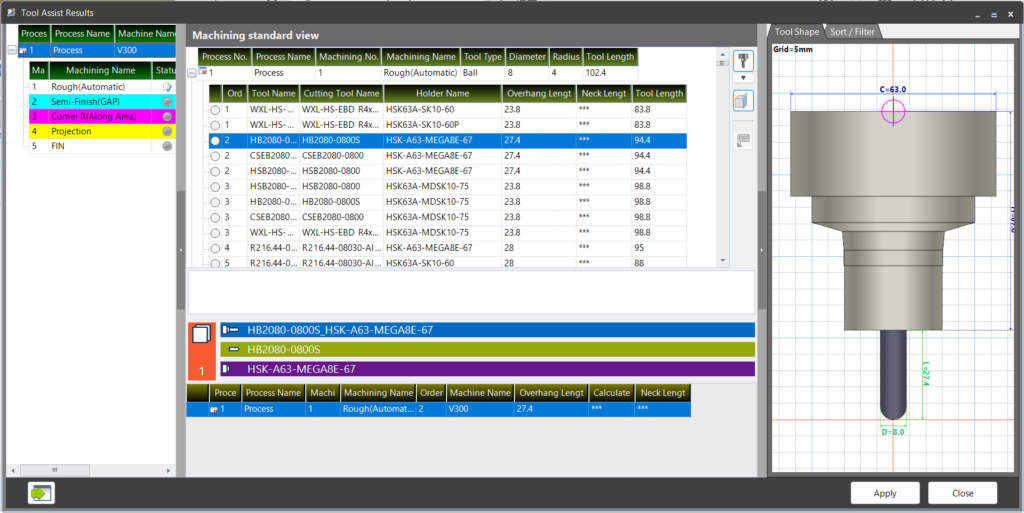
- Seamless workflow integration: A dedicated button on the Machining Data Settings screen provides direct access within the standard CAM workflow.
- Concrete recommendations: Returns specific model numbers and overhang lengths calculated for the desired tool type and diameter.
Tool Selection Workflow
Complete data-driven tool selection in three straightforward steps:
Specify the target geometry and material, the machining area, and the tool type and diameter to be used.
FFCAM automatically evaluates shank and holder interference, machine travel limits, tool rigidity, required tool length, and compatibility with the workpiece material.
Recommended tool manufacturers, model numbers, holder names, and overhang lengths are presented in list format.
Key Benefits
- Shorter programming time: Automating the trial-and-error of tool selection accelerates the entire workflow.
- Standardized quality: Systematic, well-grounded recommendations enable consistent machining programs regardless of operator experience.
- Greater safety and reliability: Because holder interference and machine limitations are accounted for in advance, rework and on-site problems are avoided upfront.